
Next Generation eCall
Automatic forwarding of rescue-relevant vehicle data to the telephony system
Starting January 1, 2026, emergency response centers and operators of public emergency infrastructures in the EU must be technically capable of receiving IP-based Next Generation eCall emergency calls. This includes full support for SIP/IMS-based data transmission to ensure that new vehicle types — which will be required to use NG eCall from that date onward — can be processed correctly.
Integration into existing emergency and dispatch systems
With Next Generation eCall in anynode, automatic vehicle emergency calls can now be integrated into existing emergency and control center systems. Modern control centers, public safety authorities, and providers of emergency communication or telematics services benefit from the fact that rescue-relevant vehicle data — the so-called Minimum Set of Data (MSD) — is transmitted directly and without detours into the telephony system. When a call is received, information such as location, vehicle type, or time of the accident is immediately available, enabling dispatchers to assess situations and instruct emergency services more effectively.
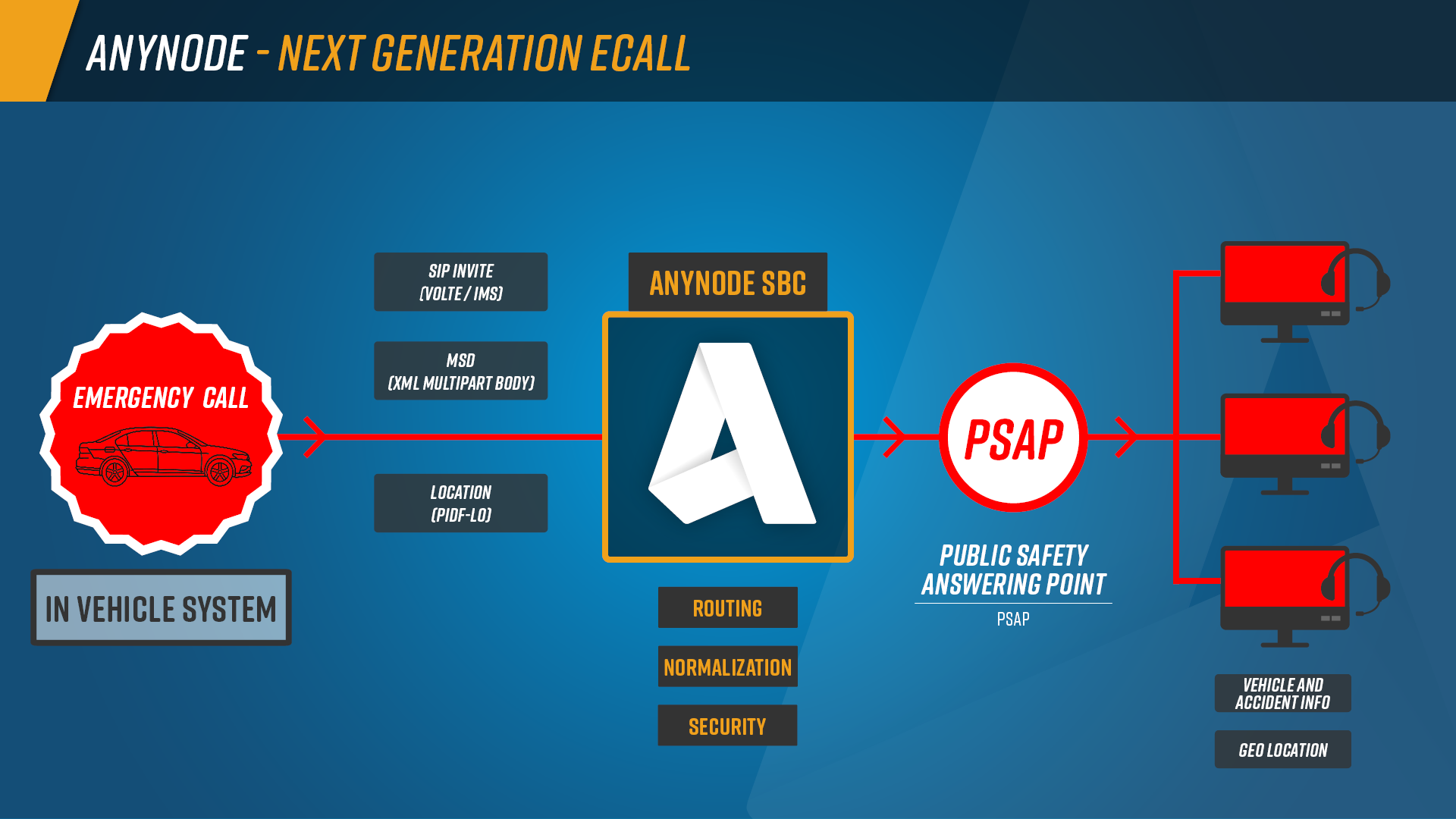
Process of a Next Generation eCall with anynode. The vehicle system sends a SIP-based emergency call with location and vehicle data (MSD) through anynode directly to the control center (PSAP). The information is immediately available to emergency personnel when the call comes in.
Modern SIP headers instead of error-prone modem signals
Unlike traditional eCall, which transmits its modem signals over the audio channel, Next Generation eCall uses modern SIP headers. This method is not only more robust and significantly faster but also reduces transmission errors. anynode ensures that these headers are processed correctly and forwarded to connected systems — regardless of whether they are municipal control centers, various Public Safety Answering Point (PSAP) infrastructures, or automotive backend communication systems. This ensures implementations remain standards-compliant and reliable, even when data must be distributed to multiple recipients.
Faster response times and error-free emergency handling
Through this direct and automated provision of all relevant emergency data, response times in critical situations are significantly reduced. Control centers can assess the situation already during call setup, follow-up questions become largely unnecessary, and the risk of human error is noticeably reduced. At the same time, automotive manufacturers and their suppliers can ensure that their vehicles’ eCall data is reliably transmitted into a wide range of control center environments — a decisive advantage in an internationally connected safety and emergency ecosystem.
Features at a glance
- Mandatory for operators of public emergency infrastructure starting January 1, 2026
- Automatic forwarding of the Minimum Set of Data (MSD) in the SIP INVITE header
- Immediate availability of location and vehicle data during emergency calls
- Correct forwarding of header data to target PSAPs
- Compatible with modern emergency call systems and control center infrastructures
- Future-proof implementation of the Next Generation eCall standard