
Performance
More power from existing hardware through optimized multi-core utilization
With anynode 4.14, existing hardware can be utilized much more efficiently, which is particularly relevant for carriers, service providers, large companies with unified communications or contact center environments, and operators of modern data centers. Optimized multi-core scaling ensures that additional CPU cores work much more efficiently: On a 32-core system, up to 2,000 simultaneous sessions can be processed without the need to purchase new hardware. Even smaller installations with 200 to 400 sessions benefit noticeably from the increased resource efficiency, which creates performance reserves in both hosting environments and integrated customer installations.
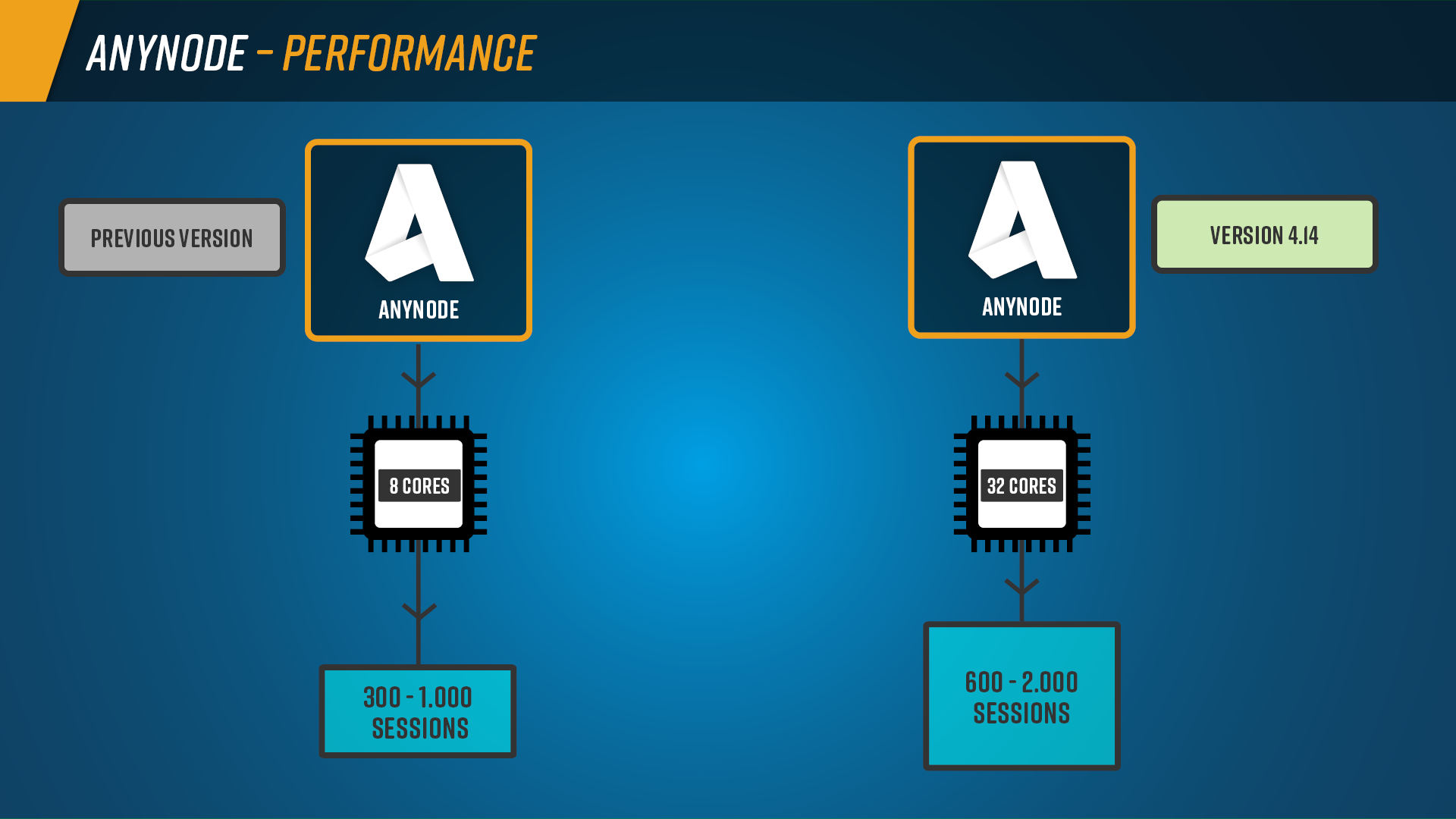
Performance boost with anynode version 4.14, reaching up to 2,000 simultaneous sessions on 32-core systems. Compared to the previous anynode version, this enables effective utilization beyond 8 cores.
Optimized performance across different platforms
The software adapts optimally to a wide range of CPU architectures and platforms. Especially under Debian and Ubuntu—but also in virtualized environments such as Proxmox, Hyper-V, or cloud scenarios on Azure and Google Cloud—significant performance gains can be achieved. Organizations that operate large SIP trunk volumes or distributed contact center installations can process more sessions per core on identical hardware—often around 50% more per doubling of the core count. Only AWS shows smaller improvements but remains reliably usable.
Stability and scalability for production environments
In data centers or during cloud migrations, the improved multi-core utilization enables more robust load distribution and increases overall system stability. In combination with the Request Router introduced in version 4.12, highly available, elastically scalable architectures can be implemented that are designed for demanding production communication environments. As a result, both large service providers with thousands of simultaneous sessions and enterprises moving their contact center workloads to the cloud benefit from higher overall performance while keeping their existing hardware footprint unchanged.
Features at a glance
- More efficient hardware utilization: Optimized multi-core scaling for better use of additional CPU cores
- Higher capacity: Up to 2,000 simultaneous sessions in standard transcoding mode on a modern 32-core system
- Broad benefits: Significantly increased performance even for smaller installations with 200–400 sessions
- Flexible deployment options: Ideal for compact setups and carrier environments with high demands on stability and performance
- Optimized architecture support: Higher efficiency on many-core systems with lower clock frequencies
- System-dependent performance gains: Best results on Debian & Ubuntu; strong improvements on Windows Server, Proxmox, Hyper-V, Azure, and Google Cloud; limited gains on AWS
- Scalable performance: +50% sessions with 16 instead of 8 cores, and another +50% with 32 instead of 16 cores
- Cost-efficient operation: Large installations with several thousand sessions achievable on standard hardware
- Enhanced high availability: Combined with the Request Router (since version 4.12), a highly available, scalable, and fail-safe system architecture can be built